← Back to projects Case structure 4-page Power BI story Core focus Discovery quality Decision Selective rollout
Product Analytics / Experimentation / Growth New product case
NovaMarket Product, Growth & Experimentation Analytics
A product analytics workflow for discovery quality, experiment impact, and rollout decisions
NovaMarket had plenty of discovery activity. That was never the issue. Users were searching, browsing, and interacting with recommendations at scale, but too much of that activity still failed to become meaningful product evaluation or cart progression. This case was built to answer a practical product question: did a new discovery treatment improve user progression enough to justify action, and if so, where should the business move first?
The business problem
Discovery volume was there. Decision quality was not.
This was not a case about vanity engagement. The company already had discovery activity at scale. What it lacked was confidence that discovery was actually helping users move forward.
Too many sessions were still stalling before reaching stronger product evaluation, cart progression, or purchase. That matters because discovery is expensive to get wrong. When users browse, search, and interact without progressing, the business pays the cost of attention without capturing much value from it.
So the real challenge was not how to get more clicks. It was how to understand where discovery was breaking down, whether a new treatment improved that journey, and what kind of rollout the results actually justified.
What I set out to answer
Four questions shaped the case.
- Is discovery genuinely the product problem, or just a noisy early-stage step?
- Where does friction really concentrate across intent, device, and visitor context?
- Did the treatment improve meaningful progression rather than surface engagement alone?
- If the treatment worked, where should rollout begin first and what should be monitored after launch?
Data and analytical setup
A product analytics model built for decision support, not generic reporting.
The case is built on a session-level product analytics mart supported by experiment summary and QA tables. The model tracks discovery sessions, product detail views, qualified consideration, add-to-cart behavior, purchase outcomes, dead-end discovery, reformulation behavior, and treatment exposure.
Power BI was used as the business-facing layer, but the project was really about the analytical logic underneath it: defining meaningful discovery quality, diagnosing friction concentration, comparing treatment versus control, and translating that into a rollout recommendation that a product or growth team could actually use.
Case walkthrough
From problem framing to rollout recommendation.
The dashboard was intentionally structured as a four-step decision story: identify the problem, locate the friction, judge the experiment, and turn that evidence into a rollout plan.
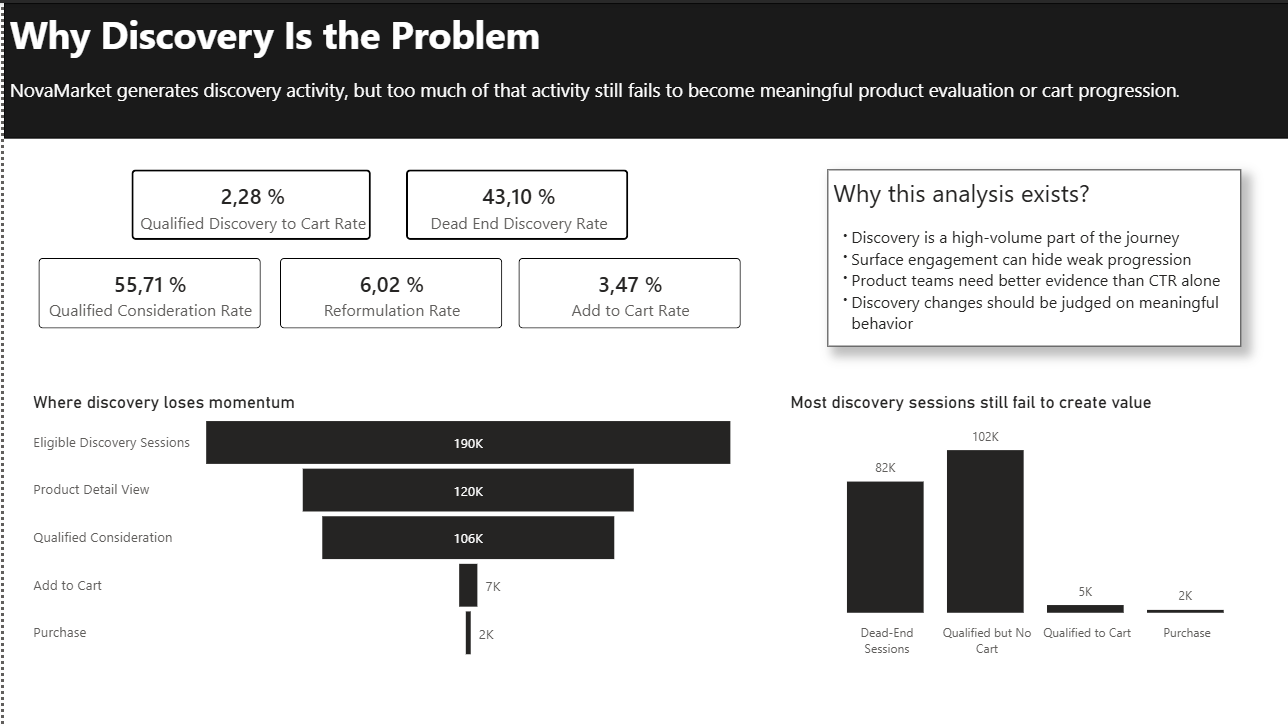
Page 1 — Why Discovery Is the Problem
The first page established the real business issue. Discovery volume was high, but too much of that activity still failed to become meaningful product evaluation or cart progression. The problem was not lack of engagement. It was weak conversion of discovery into stronger decision behavior.
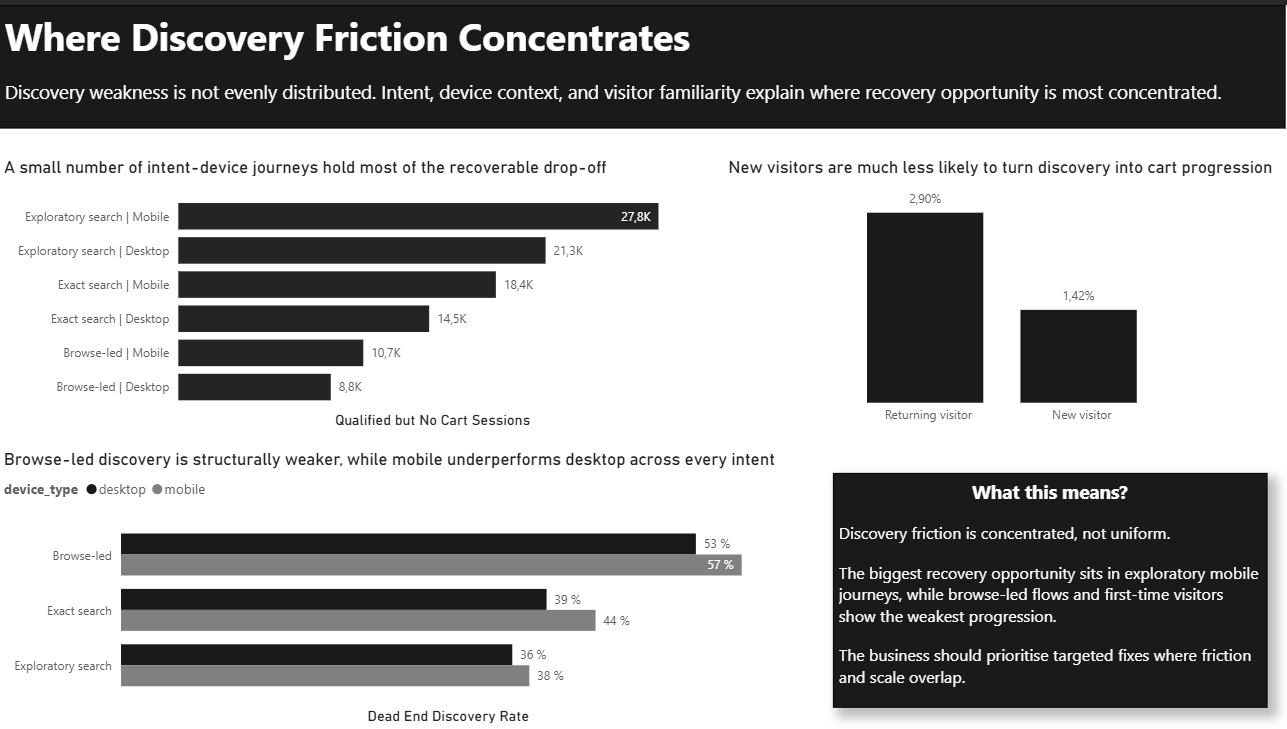
Page 2 — Where Discovery Friction Concentrates
The second page showed that the weakness was not evenly distributed. Recoverable opportunity concentrated heavily in exploratory mobile journeys, structural weakness was highest in browse-led flows, and first-time visitors progressed much less effectively than returning users.
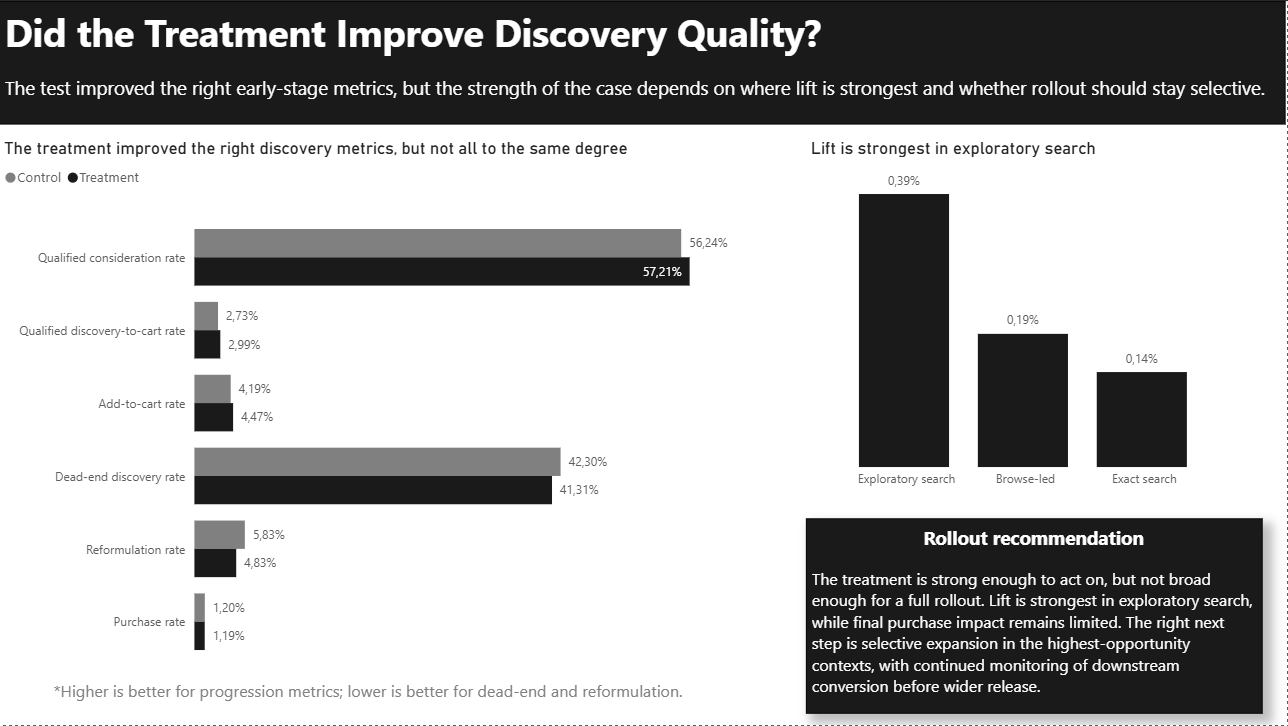
Page 3 — Did the Treatment Improve Discovery Quality?
The third page evaluated the experiment itself. The treatment improved the right early-stage metrics, especially qualified consideration, discovery-to-cart, add-to-cart, and dead-end reduction. But purchase stayed broadly flat, so the right conclusion was not blanket rollout. It was selective expansion with judgment.
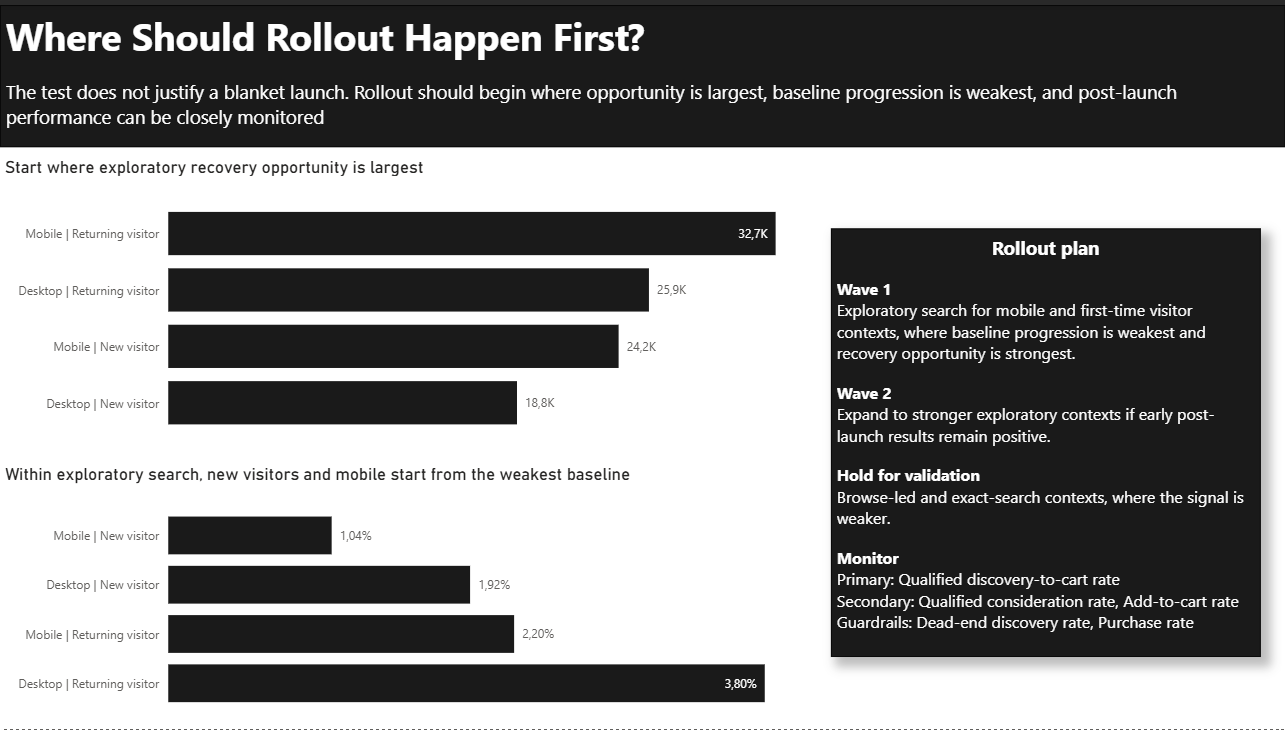
Page 4 — Where Should Rollout Happen First?
The final page turned the analysis into an action plan. Rollout should begin inside exploratory search, prioritising mobile and first-time visitor contexts where baseline progression is weakest and recovery opportunity is strongest. Broader expansion should wait until post-launch performance confirms the signal.
Final recommendation
Proceed with selective rollout, not full launch.
The treatment improved the right discovery-quality signals and showed the strongest lift in exploratory search, which is exactly where the business most needed help. At the same time, final purchase impact remained limited, so the evidence did not justify a blanket release.
The best next step is to expand first in the highest-opportunity exploratory contexts, especially mobile and first-time visitor journeys, while monitoring discovery-to-cart progression and downstream guardrails closely before broader rollout.
What this project demonstrates
What this says about the way I work.
Product analytics problem framingEvent-based behavioral logicExperiment interpretation with business judgmentFriction diagnosis across journey contextRollout prioritisation and monitoring logicBusiness-facing analytics storytelling